

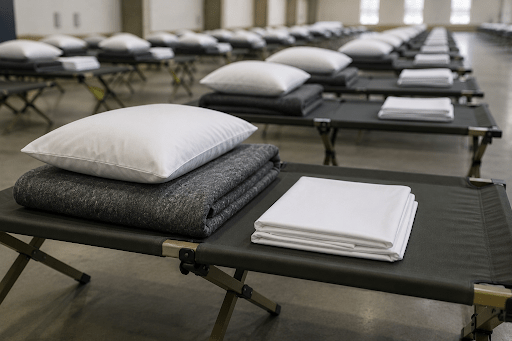
It is 2 am. A wildfire evacuation order just went out, and a school gym opens as a shelter at dawn. Someone has to source four hundred cot kits before sunrise.
That call gets made at the worst price. From whoever answers the phone. In whatever quantity is left in stock.
Shelter bedding is one of the few buys where planning ahead changes the cost a lot. Buy it in the calm season and you set the terms. Buy it during an event, and the event sets them.
Here is what to stock, what to buy for which conditions, and how to store it so it is ready.
Count Per Cot, Not Per Shelter
Shelter capacity is a moving number. A site rated for 150 people takes 200 when the weather turns.
So plan by the cot, not by the building. Build one kit, then multiply it by the number of cots you can physically fit.
The Standard Cot Kit
A working cot kit holds four things:
-
One blanket
-
One pillow
-
One sheet set, either reusable or disposable
-
One towel
That is the base unit. Some operations add a pillowcase separately, and some add a second blanket for cold-weather regions.
There is no single published rule for how much bedding a shelter must hold per person. It varies by state, by agency, and by the kind of operation you run. Use the cot kit as a planning frame, then check your own program rules.
Surge Stock Above Base Capacity
Stock above your rated capacity, not to it.
Shelters often go past their stated numbers. The overflow arrives at the worst moment. A buffer of 20 to 25 percent above rated capacity is a common working margin.
The alternative is a partial kit for the last twenty people through the door. That is a dignity problem before it is a supply problem.
Reusable or Disposable Depends on Shelter Duration
This is the biggest call in your stocking plan. It turns on two things. How long will people stay, and do you have laundry access?
When Disposable Is the Right Call
Disposable sheets and pillowcases make sense in four cases:
-
Triage areas during first response
-
Short-term evacuation centers where people stay one or two nights
-
Any site with no laundry at all
-
Surge periods when the laundry cannot keep up
You get a clean barrier per person with no washing step in between. For a shelter running at speed, that removes a whole job. Our disposable linens ship in bulk cases for exactly this use.

When Reusable Pays Back
For shelters running longer, reusable linen costs far less per night of use.
Our reusable sheets include T130 muslin and T180 cotton and polyester blends. Both are built for high-heat industrial washing. They resist tearing, pilling, and shrinking. That is what makes them pay off across a long deployment.
The break-even point depends on laundry access. If you send linen out, add that cost. If you wash on site, reusable wins fast. How you run that wash program decides how long the linen lasts, which we cover in our guide to wash temperature.
You can see both options in our emergency relief sheets and pillowcase range.
Most Operations Need Both
Most experienced operations hold both, and that is not a planning failure.
Keep a reusable base layer sized to your normal operation. Add a disposable surge layer for days when volume outruns your laundry. That disposable stock also covers you if your laundry access disappears, which happens when the same event takes out local services.
Choosing Blankets by Shelter Conditions
Blanket choice is a climate decision more than a budget one.
Cold or Unheated Shelters
Heavy-duty wool blends are the right answer for cold or unheated shelters. Wool holds heat even when damp. That matters in flood response, in unheated buildings, and anywhere people arrive wet.
That single property is why wool still wins in the hardest conditions despite costing more.
Heated or Mild-Climate Shelters
Snag-free thermals and polar fleece suit heated buildings and milder climates.
They are lighter, dry faster, and pack down smaller. That matters when you store thousands of units. For most indoor shelters in mild regions, thermal or fleece is the practical choice.
Our relief blankets cover all three constructions in neutral institutional colors.

Why Blanket Dimensions Matter More Than You Think
Here is a detail most buyers miss until they see it in a live shelter.
A blanket that is too large hangs off the cot and touches the floor. In a room with hundreds of people and shared walkways, that is a hygiene problem. It also means the blanket needs washing sooner.
Our relief blankets are sized to fit standard metal cots, military-style beds, and shelter mattresses. They give full coverage without the overhang that drags on the floor.
Check the sizes against your own cots before you order at volume. A blanket sized for a home bed is the wrong product here.
Pillows Are a Hygiene Decision, Not a Comfort One
In a shelter, a pillow is not a comfort item. It is a surface that touches someone's face for several nights.
Our emergency relief pillows use hypoallergenic polyester fill. They are filled and finished in the USA. Hypoallergenic fill matters more in a shelter than in a hotel. You are serving people whose health needs you do not know, including some who left home without their medication.
They ship compressed, which cuts the storage space they need.
For short deployments and triage, disposable pillows remove the processing question entirely.
Storage Is the Constraint Nobody Plans For
Most stockpile plans fail on storage, not on budget.
Bedding is bulky. A thousand cot kits take real warehouse space. That space usually belongs to something else eleven months of the year.
Three things cut the footprint:
-
Compressed packaging on pillows, which shrinks the bulkiest item
-
Dense bales and case packs on blankets and linens
-
Uniform case sizes, so you can palletize cleanly instead of stacking mismatched cartons
Our emergency bedding is folded and densely packed in bales or sturdy case packs for this reason. It palletizes cleanly, stores long term, and moves fast when you distribute it.
Measure your storage before you set your stocking target. A plan that does not fit the building is not a plan.
The Factory Pro Tip: Buy Before the Season, Not During the Event
The best price you will ever get on shelter bedding is in your quiet season.
Pre-season buying gets you better unit pricing and full availability. No rush fees. And time to inspect what arrived before it matters. Event buying gets you whatever is in stock, at whatever the market will bear.
Build restocking into an annual cycle instead of a response. Order after your season ends. Inspect on arrival. Rotate stock so nothing sits untested for a decade.
Buying early here is not just cheaper. It is the difference between having what you planned for and having what was left.
Surge Logistics and Lead Time
Lead time is the whole problem in disaster response, and it is where most suppliers fall down.
We hold inventory at our US facilities. That lets us process and ship pallet-load orders quickly instead of waiting on an import cycle. For active operations with a hard deadline, contact our team, and we will work the logistics around your timeline.
Ask any supplier two questions before you commit. Where does the stock physically sit? What is the real dispatch time on a pallet-load order? A six-week import lead time is not a disaster response, whatever the catalog says.
Funding, Grants, and Domestic Sourcing
Shelter bedding is often bought with federal grant money, state funds, or agency budgets. Each carries its own sourcing rules.
Where Department of Defense funds are involved, domestic sourcing rules apply no matter which agency runs the contract, which we cover in our guide to Berry Amendment compliance. Other federal programs have their own rules.
Confirm your funding source before you write the spec. Sourcing rules are far easier to build in at the start than to fix after an award.
Stocking Your Shelter Program

Plan per cot. Stock above capacity. Match blankets to your climate. Hold a disposable surge layer next to your reusable stock. And buy before your season, not during your event.
We have made institutional textiles in the United States since 1990. We supply FEMA contractors, government agencies, and relief organizations with bulk emergency bedding.
We sell direct to business, so you buy at wholesale with no reseller markup. Case-pack pricing, pallet shipping, and volume discounts are set up for agencies and relief programs buying at scale.
Request a custom quote and our team will build a stocking plan around your cot count, climate, and storage capacity.
Frequently Asked Questions
What bedding does an emergency shelter need?
Plan one kit per cot: a blanket, a pillow, a sheet set, and a towel. Some operations add a separate pillowcase or a second blanket in cold regions. Stock above your rated capacity rather than to it.
How many blankets per person in a shelter?
One per cot is the working baseline, with a second added in cold or unheated shelters. There is no single published national standard, so check your own state and agency requirements.
Should shelters use disposable or reusable sheets?
Disposable suits triage, short stays, and sites with no laundry. Reusable costs less per night for longer deployments with laundry access. Most experienced operations hold both, using disposables as a surge layer.
What kind of blankets are best for emergency shelters?
Heavy-duty wool blends for cold or unheated shelters, because wool holds heat even when damp. Snag-free thermals and polar fleece for heated buildings and mild climates, since they are lighter and pack smaller.
Do emergency blankets fit standard cots?
They should. Our relief blankets are sized for standard metal cots, military-style beds, and shelter mattresses, giving full coverage without floor-touching overhang. Check dimensions against your own cots before ordering at volume.
How should shelter bedding be stored?
Use compressed packaging for pillows, dense bales or case packs for blankets and linens, and uniform case sizes so pallets stack cleanly. Measure your available storage before setting a stocking target.
Where can I buy bulk emergency shelter bedding?
The Linen Factory manufactures institutional textiles in the USA and supplies FEMA contractors, government agencies, and relief organizations. We offer case-pack pricing, pallet shipping, and volume discounts for programs buying at scale.
Does funding affect where shelter bedding can be sourced?
Yes. Federal grants, state funds, and agency budgets each carry sourcing rules. Where Department of Defense funds are involved, domestic sourcing requirements apply regardless of which agency runs the contract.
How fast can bulk shelter bedding ship?
That depends on where the stock physically sits. We hold inventory at US facilities so pallet-load orders are dispatched quickly. Ask any supplier for their real dispatch time before you commit.
Share:
Correctional Bedding: Standards, Specs, and Sourcing
The Three-Set Rule Everyone Repeats, and the Two Exceptions Nobody Mentions