

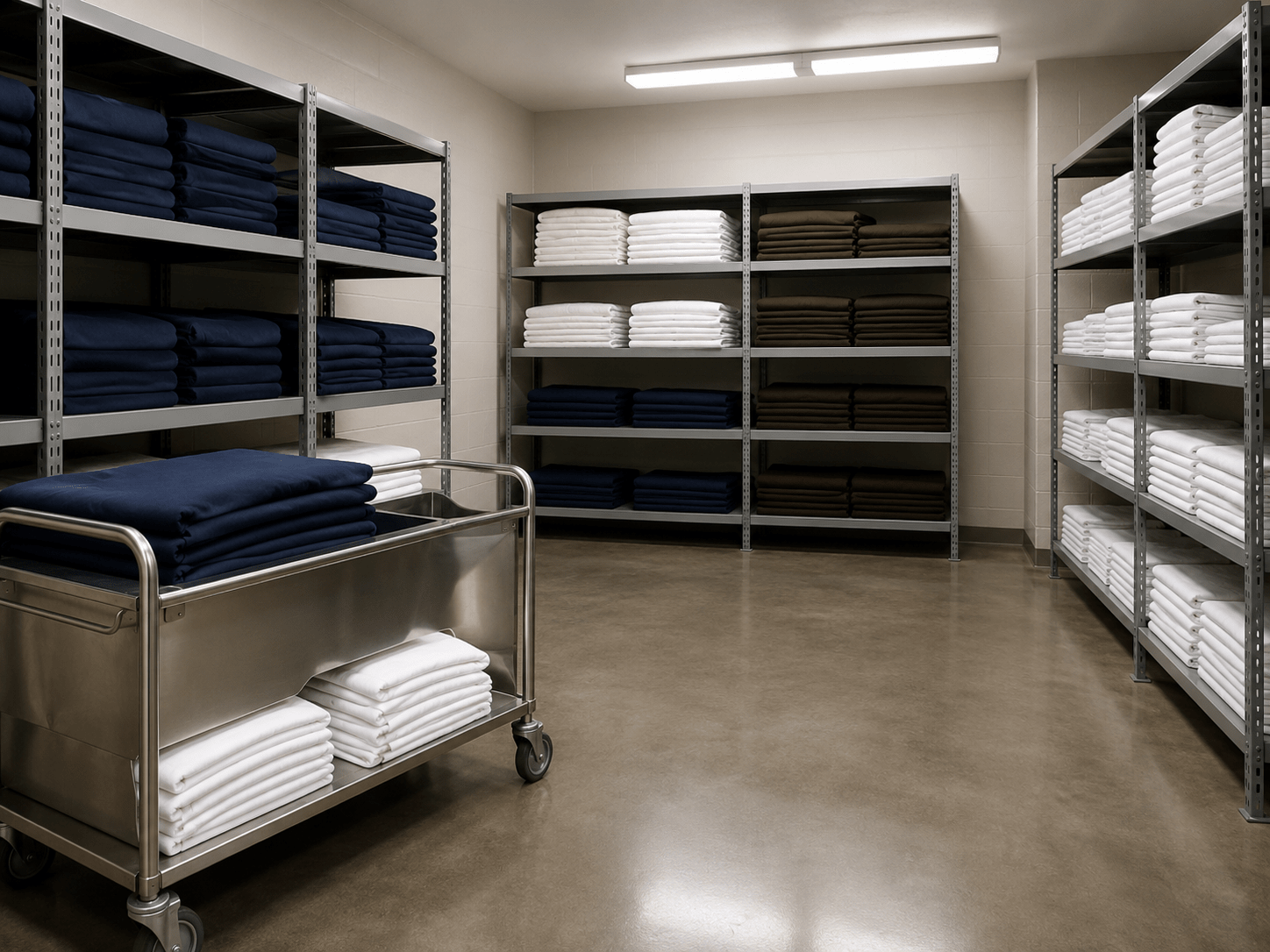
The Spec Sheet Your Auditor Reads: Correctional Bedding Standards and How to Source Them
Audit findings in jails rarely come from bad linen. They come from missing paperwork.
A facility can buy the right mattresses and issue clean sheets on time. It can still fail an audit because nobody can find the supplier's fire safety certificate. The bedding was fine. The file was not.
Correctional bedding must follow more rules than any other facility linen. Federal fire rules, ACA standards, and state law all apply at once. Each one wants something different from you.
Here is what they require, and what to ask a supplier before you buy.
Correctional Bedding Follows Three Sets of Rules
Most buyers know one set well. The other two are where findings come from.
Federal Fire Standards
Different products in the same cell answer to different tests. A blanket certificate does not cover your mattresses.
-
16 CFR Part 1633 covers mattress fire safety. This is the federal open flame standard.
-
California Technical Bulletin 129 covers facility mattresses. Many states outside California use it too.
-
ASTM D4151 covers blankets.
-
16 CFR 1610 covers textiles used in clothing.
Fire risk is higher in a jail for an obvious reason. People cannot leave their cells on their own. One burning sheet fills a small space with smoke fast. That is why every fire rule in this group exists.
ACA Accreditation and Linen Exchange
The American Correctional Association accredits over 900 facilities. About 80 percent of state corrections departments take part. Its standards are the working benchmark for the industry.
ACA Core Jail Standards require clean bedding and linens for every inmate. They also require linen exchange, including towels, at least once a week. The process indicator is documentation of issue and exchange.
Read that last line again. Exchanging linen does not meet the standard. Exchanging linen and proving you did meets the standard.
Your linen program is an audit record, not just a supply job.
State Codes and the Proof Burden
State law adds more rules on top. Wisconsin DOC 348.07 shows how detailed these get.
-
Clean sheets, pillowcases, blankets, and towels on admission.
-
Sheets and pillowcases changed and washed at least weekly.
-
Clean towels and washcloths twice a week.
-
Blankets laundered or sterilized before reissue and at least every three months.
-
Mattresses at least three inches thick.
-
Mattresses and pillows made of fire resistant fabric with waterproof, easy to clean covers.
That last line drives your pillow spec. Correctional sleeping pillows need a fire resistant fill and a wipeable cover, not a hospitality build.
One line matters most for buying. Suppliers must give the sheriff evidence that products are fire resistant, fire retardant, waterproof, and easy to clean.
Your supplier carries the proof burden. If they cannot meet it, the finding lands on you.
Check your own state code. Exchange rules, mattress thickness, and proof requirements change from state to state.
Why Hotel Linen Fails in a Jail
Facilities that buy on price alone often end up with hotel goods. Those goods fail in ways buyers do not expect.
The Thread Count Trap
Higher thread count sounds better. In a hotel, it often is. In a jail it is the wrong measure.
High thread count fabric uses finer yarn. Finer yarn dries slower and costs more to replace. It gives you nothing in a place where linen is swapped weekly and washed hard.
Tight weave matters far more. A tight weave resists snagging and holds its shape through hot cycles. It also dries fast enough to keep up with weekly exchange.
Where T-130 and T-180 Fit
These two constructions run most jail bedding. Both are cotton polyester blends, often 50/50 or 55/45. They are built to last and dry fast, not to feel soft.
-
T-130 is the budget option. It suits intake and holding, where turnover is fastest and stays are short.
-
T-180 is more durable and softer. It suits general population housing, where linen stays in use longer.
Our correctional sheets and pillowcases are filled, sewn, and finished in the USA in both weights.

Color is a security choice, not a design one. Dark brown, navy, and orange are standard. They help staff spot housing units, hide stains between exchanges, and make hiding items harder.
Safety Bedding for High Risk Housing
Observation units, mental health housing, and intake need more than general population bedding. This spec is a safety control. Treat it like one.
What Tear Resistant Actually Means
Tear resistance comes from construction, not from a label. Three things create it.
-
The base fabric. Safety blankets often use heavy coated nylon. Tear resistant sheets are often woven polyester rather than a cotton blend.
-
The fill and stitching. Resin bonded polyester batting, quilted with close box stitching, so the blanket cannot be pulled apart into pieces.
-
The assembly. Reinforced seams, hidden or removed fasteners, and one piece designs with no parts that come off.

Safety blankets run around 15 ounces per linear yard. That is much heavier than a general population blanket.
Writing Specs for Observation and Mental Health Units
Match the product to the housing unit. Do not put one product across the whole facility.
Safety bedding costs more and is not needed in general population. General population bedding is not enough in observation.
Write the housing assignment into your spec. Then procurement, laundry, and housing staff all work from the same document. Facilities that leave this to habit end up with the wrong product in the wrong unit.
Bring your medical and mental health staff into the spec. They will know whether a product fits your observation policy. Their input also carries weight if the spec is ever reviewed.
Fire Performance Is Not One Number
Buyers often ask if a product is fire retardant, hear yes, and stop. That question is too broad to help.
Inherent Versus Treated Fire Resistance
Inherent fire resistance lives in the fiber itself. Washing does not reduce it.
Treated fire resistance is a coating applied to the fabric. It can wear off over many wash cycles.
That difference matters a lot here. Linen is swapped weekly and washed hard. A treated blanket that passes when new may not perform the same after a hundred heavy cycles.
Ask which type you are buying. If it is treated, ask how many wash cycles the rating covers. Our fire retardant correctional blankets are built for this environment.
Certificates to Request
Ask for the test certificate itself, not a claim on a sales sheet. Check four things.
-
Which standard the product was tested against.
-
That the cert covers the exact product and construction you are ordering.
-
The date on the certificate.
-
That you have a separate certificate for each product type.
File it before the product goes into service. Finding paperwork two years later during an audit is much harder than asking for it at purchase.
Laundry Wears Out Jail Linen Faster Than Anything Else
No linen takes more punishment. Weekly exchange across a full population, harsh chemicals, and hot water add up fast.
Wash temperature is the biggest factor you control. Running hotter than you need shortens replacement cycles a lot. Our guide to wash temperature covers the tradeoff, and the math applies straight to jail volumes.
Chlorine deserves a hard look here. It breaks down cotton fiber every cycle. Facilities using heavy chlorine to fight stains are often paying for it in replacement costs without seeing the link. Our guide to bleach alternatives explains what replaces it and what the CDC actually requires.
Blankets have their own rule in many states. Some codes require washing at set intervals no matter how much a blanket was used. Build that cycle count into your service life math from the start.
The Factory Pro Tip: Buy the Paperwork, Not Just the Blanket
Vendors sell products. Auditors read files. Correctional buying has to satisfy both.
Put paperwork in the purchase order. Do not chase it later. List fire certificates, construction specs, and fiber content as required items. Give them the same weight as delivery date and price.
Ask three questions before you award.
-
Which standard was this tested against?
-
Is the fire resistance inherent or treated?
-
Can you send the certificate for this exact construction?
A supplier who answers right away and in writing has done this before. A supplier who needs to check and call you back is telling you something.
Funding Changes Your Sourcing Rules
Correctional buying often crosses federal funding lines. That changes where your products can come from.
Federal grants, Department of Defense funds, and state contracts each carry their own domestic sourcing rules. Where Department of Defense money is used, the Berry Amendment applies no matter which agency runs the contract.
Confirm your funding source before you write the spec. Domestic sourcing rules are far easier to build in at the start than to add after award.
Facilities buying across several facility types can order through one government and institutional bedding range and keep sourcing paperwork in one place.
Specify It Once, Pass Every Audit
Correctional bedding is a paperwork job wrapped around a linen purchase. The facilities that pass audits cleanly are not the ones spending the most. They are the ones whose spec, purchase order, and file all say the same thing.
-
Write the spec by housing unit, not by facility.
-
Require certificates as contract items, not follow up requests.
-
Match construction to your laundry program, not your price target.
-
File everything before the product reaches a housing unit.
Our full correctional textiles range is built around these rules. Rules vary by state and by accrediting body. This article explains how the standards work. Check your own state code and ACA rules for your exact duties.
Request a custom quote and our team will work through your housing types, paperwork needs, and volume pricing.
Frequently Asked Questions
What bedding do correctional facilities use?
Most jails use T-130 or T-180 cotton polyester sheets in security colors, fire retardant blankets, and pillows with wipeable covers. High risk housing uses tear resistant safety bedding built to different standards.
What is tear resistant correctional bedding?
Tear resistant bedding uses heavy-coated fabrics, reinforced seams, close box stitching, and one piece construction with no removable parts. It is used in observation, intake, and mental health housing rather than general population.
What fire standards apply to correctional bedding?
Mattresses fall under 16 CFR Part 1633 and often California Technical Bulletin 129. Blankets are commonly tested to ASTM D4151. Textiles used in clothing fall under 16 CFR 1610. Each product type needs its own certificate.
What is the difference between T-130 and T-180 sheets?
Both are durable cotton polyester blends built for hard laundering. T-130 is the budget option and suits intake and holding. T-180 is more durable and softer, and suits general population housing.
How often must correctional linen be exchanged?
ACA Core Jail Standards require linen exchange, including towels, at least once a week, with documentation of issue and exchange. State codes may require more, such as towels twice weekly.
Are correctional blankets required to be fire retardant?
In most states, yes. State codes commonly require fire resistant bedding, and many require suppliers to provide written proof. Check the rule in your own state code.
What paperwork should a correctional bedding supplier provide?
Fire test certificates naming the exact standard and construction, fiber content and construction specs, and proof that covers are waterproof and easy to clean. Ask for these in the purchase order.
Does the Berry Amendment apply to correctional bedding?
It applies when Department of Defense funds are used, because Berry follows the funding rather than the agency. Other funding sources carry their own rules, so check your funding before writing the spec.
Share:
Berry Amendment Bedding: A Buyer's Compliance Guide
What a Shelter Needs Per Cot: Stocking Emergency Bedding Before You Need It