

It is 11 am on a same-day turnover. Your cleaner texts a photo of a stained fitted sheet. Check-in is at 3 pm.
If you own three sets, this is a minor annoyance. If you own two, you are driving to a store or messaging a guest.
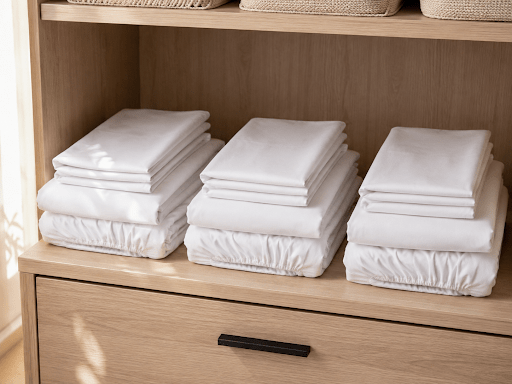
So how many sets of sheets do you need for a vacation rental? Three per bed is the industry standard. One on the bed, one in the wash, one in the closet.
But that rule does not apply to everything in the room. Two categories break it, and buying them at three sets wastes money and closet space.
Here is the full math, and what to buy once you have it.
What the Three-Par Rule Actually Means
Par is a hotel term for how much stock you keep on hand. Three-par means three complete sets for every bed.
The three sets do different jobs:
-
One set is on the bed right now.
-
One set is in the wash or at the laundry.
-
One set sits clean in the closet, ready to go.
Most vacation rental sources agree on this number. The reasoning is the same across all of them: your turnover should never depend on a laundry cycle finishing.
Why Two Sets Is Not Enough
With two sets, the wash cycle sits between you and your next guest.
That works until something goes wrong. A stain needs a second wash. The dryer takes longer than planned. Your cleaner runs late from another property.
Every one of those turns into a scramble. The third set removes that risk for a one-time cost, and because you rotate three sets instead of two, each one spends less time in the wash and lasts longer.
Our par level calculator will run these numbers against your own bed count and occupancy.

Exception One: Not Everything Needs Three Sets
Here is what most guides miss. The three-par rule applies to items you change after every guest.
Some items are not changed every time. For those, the industry uses about 1.25 par instead.
Items that follow the lower standard:
-
Mattress protectors
-
Pillow protectors
-
Sleeping pillows
-
Comforters and duvet inserts
-
Blankets and bedspreads
These get changed on a schedule or when soiled, not after every checkout. Stocking three of each ties up cash and fills your storage closet for no reason.
What 1.25 Par Looks Like in Practice
Take a four-bed rental.
At three-par, you would buy 12 mattress protectors. At 1.25 par, you buy five. One on each bed, plus one spare to cover the item that comes out of service.
That is seven fewer protectors. Multiply it across pillow protectors, comforters, and blankets, and the savings fund most of your third sheet set.
Because these items stay on the bed between guests, protection matters more than quantity. Our mattress and pillow protectors include bed bug encasements that fully enclose the mattress or pillow, which is the difference between a protector that catches a spill and one that protects your investment underneath. We sell them by the dozen, so a single order covers a multi-property portfolio.
Exception Two: Multiple Bed Sizes Break the Math
Par is calculated per bed size, not per property. This trips up almost every new host.
A three-bedroom rental with a king, a queen, and two twins is not one calculation. It is three separate ones.
Here is how it works out at three-par:
|
Bed size |
Beds |
Sheet sets needed |
|
King |
1 |
3 |
|
Queen |
1 |
3 |
|
Twin |
2 |
6 |
That is 12 sheet sets, not three. And a spare king set does nothing for you when the twin sheet is the one that got stained.
If you run more than one property, standardizing bed sizes across them is the single easiest way to cut linen spend. We stock Twin, Full, Queen, and King in every collection, with hospitality-standard deep pockets on fitted sheets, so one spec covers every bed you own. Custom sizing is available on larger orders.
Towel Math Is Different From Sheet Math
Towels are counted per guest, not per bed. That is the second thing hosts get wrong.
The common standard is two full towel sets per guest, plus spares. A rental sleeping six needs 12 towel sets in rotation, not six.
What Counts as a Towel Set
One set means a bath towel, a hand towel, and a washcloth.Bath mats are counted separately. Plan one per bathroom per stay, plus backups.
Towels wear out faster than sheets because they absorb more, get washed hotter, and take more abrasion. Our towel and terry range is built from ring-spun cotton for exactly this reason, and it ships in bulk case packs so replacement is a reorder rather than a shopping trip.
Our guide to towel absorbency explains what causes decline and how construction resists it.
Pool, Beach, and Hot Tub Stock
Keep these completely separate from bath linen.
Chlorine, sunscreen, and self-tanner destroy white terry fast. Once a towel goes to the pool, it should never return to the bathroom.
Buy these in a different color so nobody mixes them up. Guests will use whatever is closest, so the separation has to be visible.
Why Retail Sheets Fail in a Rental

Retail bedding is built for a household that washes once a week. Your rental washes after every stay. That difference is the whole problem.
The Numbers Sources Actually Report
Published figures vary quite a bit, and it is worth being honest about the range.
Retail sheets are commonly reported to last 50 to 100 washes before visible wear. Commercial and hospitality grade sheets are typically reported at 200 or more, with some suppliers claiming considerably higher.
Treat the exact numbers with caution. They come from suppliers rather than independent testing, and results depend heavily on your wash temperature and chemistry.
The direction is consistent though. Commercial construction survives frequent laundering. Retail construction does not.
What We Build Differently
We have manufactured institutional textiles in the United States since 1990, and everything we make for vacation rentals is engineered for high-heat, high-friction commercial washers and dryers rather than a home machine.
That shows up in specifics:
-
Blends selected for reduced shrinkage, so a fitted sheet still fits after fifty washes
-
Whiteness retention that holds up under repeated laundering
-
Permanent press finishes that come out of the dryer looking made, not creased
-
Hospitality-standard deep pockets that stay on the mattress through a guest's stay
-
Bulk case packs at wholesale pricing, because replacement should be planned
Our vacation rental essentials collection was built specifically around this: quick-dry towels, stain-resistant sheets, and mattress protectors that survive frequent guest rotation while still looking five-star.
The Thread Count Argument, Settled
Consumer articles tell hosts to buy 300 to 400 thread counts. Hospitality suppliers say T-180 to T-300. Both camps are confident, and they are talking about different things.
Retail thread count is a marketing number, sometimes inflated by twisting thin, weak fibers together to raise the count without improving the sheet. Hospitality "T" numbers are a construction spec, not a sales label.
Which of Our Collections Fits Your Property
We manufacture from T130 to T500 in both 100% cotton and cotton-poly blends, which means the right answer depends on your nightly rate and turnover speed rather than on a single recommendation.
|
Collection |
Spec |
Best for |
|
T200 percale, 70% cotton / 30% polyester |
Most vacation rentals. Crisp, permanent press, minimal wrinkling, fast drying |
|
|
T250 percale, 100% cotton |
Hosts wanting a softer natural fiber feel with dependable durability |
|
|
Luxe Collection |
300 TC cotton-poly blend |
Upscale properties. Softness that improves with laundering |
|
Premiere Collection |
T300 percale, 100% cotton |
Premium listings where the bed is the review |
The Choice Collection is where most hosts land, and it is worth explaining why. The 70/30 blend gives you cotton's breathability with polyester's recovery, so it resists wrinkling out of the dryer and holds its shape through repeat washing. The permanent press finish means a bed looks polished without ironing, which matters when your cleaner has ninety minutes to reset the whole property.
It also runs as a full range: fitted sheets, flat sheets, pillowcases, duvet inserts, and duvet covers all in the same spec, sold in cases of twelve.
Why Ultra-High Thread Count Fails Here
Very high thread counts use finer, multi-ply yarns. Those pills are faster under frequent washing.
They also dry slower. On a same-day turnover, drying time is not a small detail.
You pay more upfront and replace sooner. That is the wrong trade for a rental. Our guide to fabric weight and GSM covers how to read these specs properly.
The Factory Pro Tip: Buy White, and Buy It Once
White wins for four practical reasons:
-
It can be treated aggressively for stains
-
It signals cleanliness to guests, because nothing is hidden
-
It photographs well for your listing
-
It removes sorting problems across rooms and properties
Colored sheets look stained even when they are perfectly clean. That is a review risk you do not need.
Then standardize. Pick one collection and one size range across as many beds as you can. Replacement becomes a reorder instead of a shopping trip, and your spare sets cover more beds.
Because we manufacture rather than resell, the spec you buy this year is the spec you can reorder next year. Hosts who buy retail discover the opposite when a product line quietly changes and their new sheets no longer match the old ones on the same bed.
Cost Per Stay Beats Cost Per Set
The cheapest sheet is rarely the cheapest sheet.
Work it out per night instead. A set that costs less but lasts a third as long costs you more over the same period, plus the time spent reordering and the risk of running short mid-season.
Buying by the case rather than the set lowers your cost per unit, and buying on a replacement schedule rather than in an emergency always costs less. That is easier to plan when you know your par numbers, which is why a replacement plan is worth writing before your season starts.
Stocking Your Rental

Buy sheets at three-par, protectors and pillows at 1.25, and count towels per guest rather than per bed.
Then buy commercial grade the first time. Hosts who start with retail bedding almost always replace it within a year and pay twice.
Shop our vacation rental essentials for quick-dry towels, stain-resistant sheets, and mattress protectors built for frequent guest rotation. We have been a direct-to-business supplier manufacturing in the USA since 1990, so you buy at wholesale with no reseller in between, in bulk case packs with low minimums for single-property hosts.
Managing several listings? Request a custom quote and our team will work out your par levels, spec, and volume pricing across the whole portfolio. We offer volume discounts for management companies and multi-property operations.
Frequently Asked Questions
How many sets of sheets do I need for a vacation rental?
Three complete sets per bed is the industry standard. One goes on the bed, one is in the wash, and one waits clean in the closet. Calculate separately for each bed size in the property.
What is the 3-par rule?
Par is a hotel term for stock kept on hand. Three-par means three full sets per bed, so a turnover never waits on a laundry cycle. It also spreads wear across more linen, which extends the life of every set.
How many towels should I provide per guest?
Two full towel sets per guest, plus spares. One set means a bath towel, hand towel, and washcloth. Bath mats are counted separately, at one per bathroom per stay.
Do I need three mattress protectors per bed?
No. Protectors, pillows, comforters, and blankets are not changed after every guest, so about 1.25 per is standard. For four beds, that means roughly five protectors instead of twelve.
What thread count is best for Airbnb sheets?
T200 in a cotton-poly percale blend suits most rentals, balancing comfort, durability, and fast drying. Our Choice Collection sits at T200 in a 70/30 blend. Very high thread counts pill sooner and dry slower, which works against same-day turnovers.
Should Airbnb sheets be white?
Yes, in almost every case. White can be treated for stains, signals cleanliness to guests, photographs well, and removes sorting problems across rooms. Colored sheets can look stained even when clean.
How long do vacation rental sheets last?
Retail sheets are commonly reported to last 50 to 100 washes, while commercial-grade sheets are reported at 200 or more. Actual life depends heavily on wash temperature, chemistry, and how often you turn the property.
Is hospitality bedding better than retail for a short-term rental?
Yes, for a property washing after every stay. Commercial construction uses blends selected for reduced shrinkage, whiteness retention, and deep pockets that stay on the mattress. Retail bedding is designed for weekly household washing.
How many sheet sets do I need for a 3 bedroom rental?
It depends on bed sizes, not bedroom count. A king, a queen, and two twins at three-par needs twelve sets total, split three per size and six for the twins. Spare sets only help if they match the bed.
Where can I buy bulk sheets for a vacation rental?
The Linen Factory is a direct-to-business manufacturer supplying vacation rentals with wholesale bulk case packs. We have manufactured in the USA since 1990 and offer volume discounts for multi-property operators.
Share:
What a Shelter Needs Per Cot: Stocking Emergency Bedding Before You Need It