

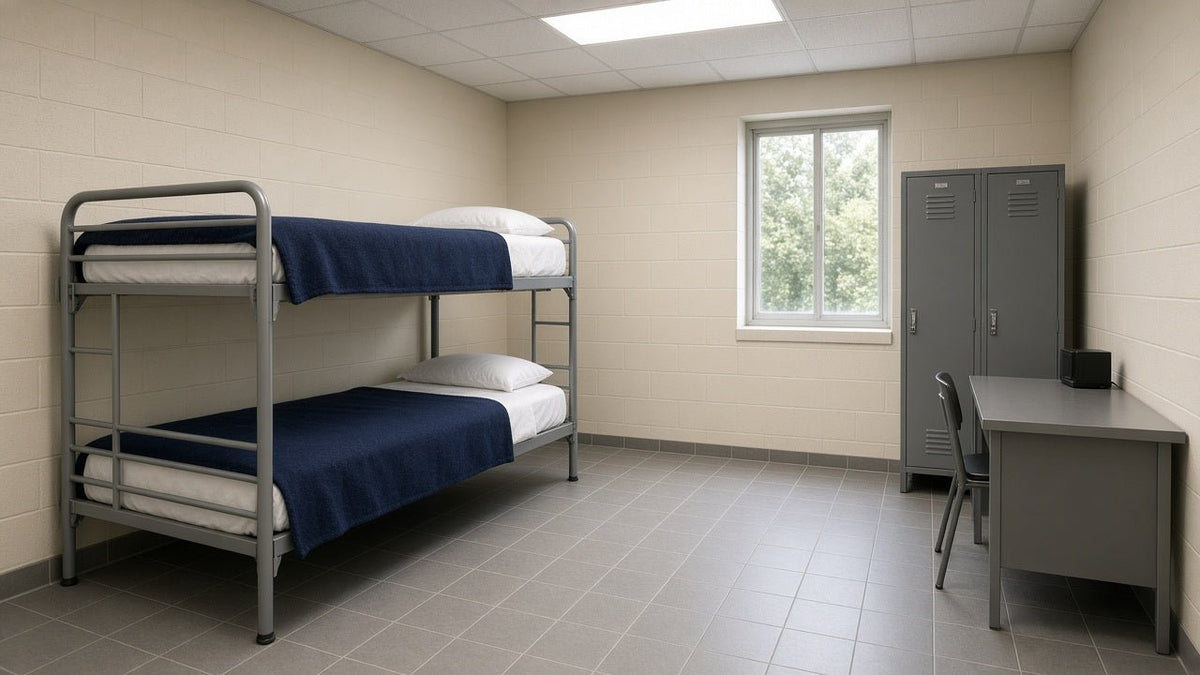
Short answer: Navy unaccompanied housing (UH / barracks) and Navy lodging are two different linen jobs.
- Unaccompanied housing needs durable, inspection-ready kits that survive frequent laundry and high turnover: sheets, sleeping pillows, comforters or blankets, mattress protectors, towels and laundry bags.
- Navy lodging needs hotel-grade presentation for temporary lodging guests: smoother sheets, finished bed looks, towels that support a short stay, and par levels built for checkout laundry.
Paradise Pillow, Inc. (The Linen Factory) supplies Navy bases and unaccompanied housing nationwide with quality bedding. Below is how the two programs differ, what belongs on each bed, and how buyers reorder through GSA, a Government Purchase Card or a BPA.
Barracks vs lodging: two different linen jobs
| Unaccompanied housing (barracks / UH) | Navy lodging | |
|---|---|---|
| Job of the bed | Daily living for Sailors in residence | Short-stay comfort for travelers and TDY |
| Look | Clean, uniform, inspection-ready | Hotel-like, guest-facing |
| Wear pattern | Heavy laundry, high loss risk | Checkout turns, guest expectations |
| Typical top layer | Comforter or blanket (sometimes both) | Comforter or duvet look |
| Laundry bags | Common issue item | Rarely part of the guest kit |
| Buying pattern | Kits and repeat BPA restocks | Room-count pars and seasonal surges |
Treating both programs as one “military sheet” line is how the wrong product arrives. UH managers optimize for durability and accountability. Lodging managers optimize for guest feel and housekeeping speed. Order each lane on its own requirement.
What an unaccompanied housing bed needs
A complete UH bed usually includes:
- Fitted sheet;
- Flat sheet;
- Sleeping pillow;
- Pillowcase;
- Comforter or blanket;
- Mattress protector;
- Laundry bag;
- Bath towel and washcloth (when issued with the bed).
Stock spare sets so a laundry delay never leaves a room unready. Most UH teams issue these as a kit at move-in and reorder the same kit contents year-round.
Sheets for barracks living
Measure mattresses before you buy. Twin XL and standard twins often sit in the same building after furniture refreshes. A short fitted sheet fails inspection and creates daily work for residents and staff. Send length, width and depth and we will match the sheet.
Poly/cotton blends are the UH workhorse: they wrinkle less, shrink less and dry faster than most 100% cotton in commercial laundry. Thread count matters less than fiber and weave for barracks use. If your lodging rooms need a guest-facing tier, see our hotel sheet thread count guide and keep those tiers off the UH kit unless you intentionally want one standard.
Comforters, blankets and protectors
Most unaccompanied housing we supply chooses comforters for a finished look that still launders in a commercial machine. Where climate or building heat calls for it, add a blanket for winter. A mattress protector is cheaper than replacing mattresses and speeds turnover after spills.
Laundry bags: nylon mesh and closed-weave nylon
Laundry bags are one of Paradise Pillow’s biggest sellers for barracks and dorms. Many UH programs stock both types.
Nylon mesh suits wash-in-the-bag use and airflow when damp items sit between laundry runs. Closed-weave nylon suits privacy, hauling and bulk collection at move-out. A common setup is one mesh bag per resident for personal wash and closed-weave bags for collecting bed linens at turnover. Ask about adding a laundry bag to every move-in kit.


What Navy lodging needs
Navy lodging runs closer to a hotel than a barracks. Guests notice the bed first. Housekeeping needs linens that press or finish quickly between checkout and the next arrival.
Priorities that differ from UH:
- Sheet tier and hand feel. Lodging often steps up from the barracks blend to a midscale or better hospitality tier. Match the tier to the property standard, not to the UH catalog.
- Towels. Bath and hand towels plus washcloths turn with every stay. Plan towel par separately from sheet par; towels fail differently and dry on a different schedule.
- Presentation. Consistent whites, matched pillow presentations and a finished top layer matter more than in barracks housing.
- Surge planning. Holiday leave, training cycles and event weekends create short spikes. Keep shelf stock for peak weeks rather than waiting for a shortage.
Lodging buyers can reuse hospitality guidance for sheet tiers and laundry while still ordering through government channels when that is how the account buys.
How much spare stock to keep
Plan by the bed, not the building. A common UH starting point is three sheet sets per bed: one on the bed, one in the laundry, one on the shelf. Then adjust for:
- Laundry turnaround time;
- Arrival peaks around permanent change of station (PCS) and training cycles;
- Loss and reject rates.
Pillows, comforters or blankets, protectors, towels and laundry bags need spares at lower ratios. Our par level calculator does the math.
Factory Pro-Tip: Write UH and lodging as two line items on the same RFQ if one office buys both. Same vendor, two kits—so barracks durability and lodging presentation do not get averaged into one compromise product.
How to order: GSA, GPC and BPA
- Through GSA: Paradise Pillow, Inc. (The Linen Factory) holds GSA MAS contract 47QSMS26D002G. Our guide How to Buy Bedding Through GSA covers GSA Advantage, eBuy and Blanket Purchase Agreements. Contract details: Government, Military & GSA.
- By Government Purchase Card (GPC): accepted on direct orders—useful for smaller, urgent restocks.
- By BPA: best when UH or lodging reorders the same kit contents several times a year.
Lead times: small orders typically ship 3–5 days after receipt of order (ARO); medium orders 7–14 days ARO. Large or custom kit orders take longer, and we put a dated delivery commitment in the quote.
If Department of Defense funds are paying, the Berry Amendment can apply. We offer Berry-compliant products; ask which items qualify. See our Berry Amendment bedding guide.
Common mistakes to avoid
- Ordering one sheet program for both UH and lodging.
- Leaving sleeping pillows or laundry bags off the UH kit.
- Running at one set per bed with no laundry buffer.
- Waiting until PCS season to reorder.
- Writing a requirement that says only “sheets, white” without mattress depth or kit contents.
Frequently asked questions
Do you supply the Navy? Yes. We supply Navy bases and unaccompanied housing nationwide with quality bedding.
Should barracks and lodging use the same sheets? Usually not. UH prioritizes durability and inspection-ready consistency. Lodging prioritizes guest feel. Keep the kits separate even if one office buys both.
Do laundry bags belong in the UH kit? Yes for most programs. Mesh and closed-weave nylon solve different jobs; many sites stock both.
Can we pay with a government purchase card? Yes. We accept the GPC on direct orders, and buyers can also purchase through GSA Advantage on contract 47QSMS26D002G.
Are your products Berry-compliant? We offer Berry-compliant products; ask which items qualify.
Related guides
- How to Buy Bedding Through GSA
- What Bedding Do Air Force Dorms Need?
- Berry Amendment Bedding: A Buyer’s Compliance Guide
- Hotel Sheet Thread Count (for lodging tier choices)
Request a government quote
Tell us whether you are stocking unaccompanied housing, lodging or both; bed counts; mattress sizes; kit contents (including pillows, towels and laundry bags); and delivery location. We’ll reply with pricing and lead time.
Request a government quote · (215) 225-8700 (press 1 for sales) · GSA contract 47QSMS26D002G · SIN 314120 · GPC accepted
Branch names are used only to identify customers we serve. No endorsement by the U.S. government, the Department of Defense (Department of War), the Department of Homeland Security or any military service is implied.
Share:
What Bedding Do Air Force Dorms Need?