

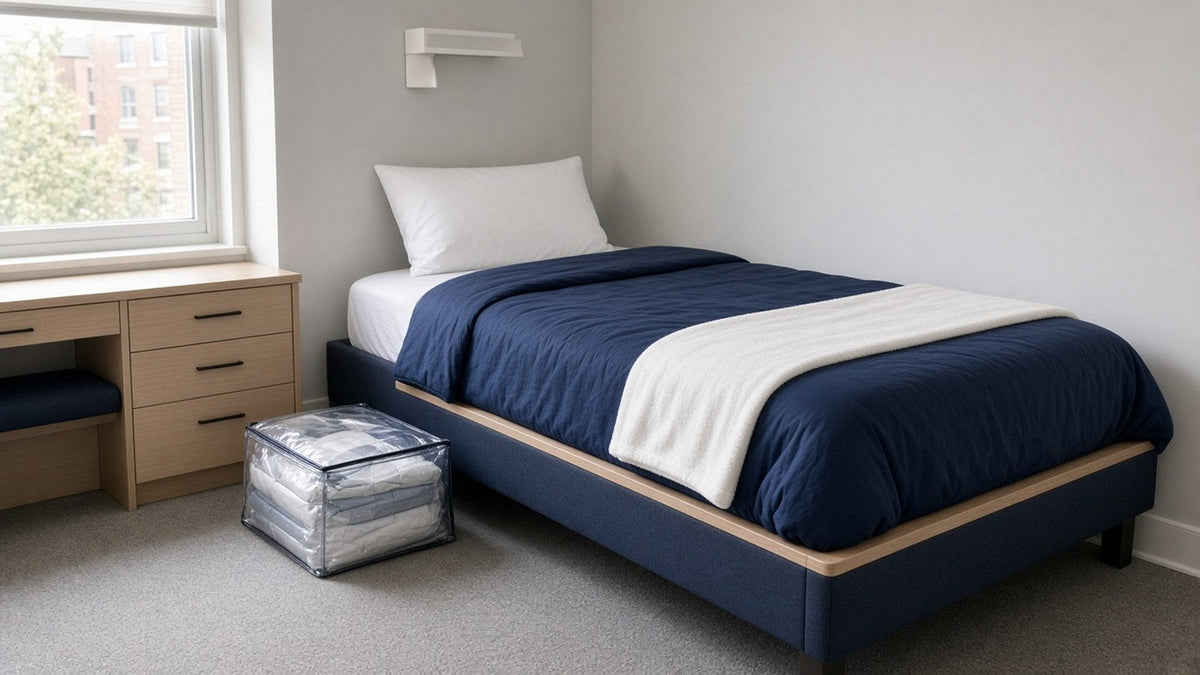
Short answer: A twin XL bed-in-a-bag usually includes a fitted sheet, a flat sheet, a pillowcase and a comforter or blanket, all sized for the longer twin XL mattress and packed together in one bag. Many residence halls also add a sleeping pillow, a mattress protector and a laundry bag, and some add a towel and washcloth. You choose the contents. The point of the kit is that one bag makes one bed.
Housing offices like kits because they’re simple. One kit per bed means one item to count, store and hand out. This guide covers what goes inside, which add-ons are worth it, how kits are packed and when to order so they’re on the shelf before residents arrive.
Why twin XL changes the order
Most residence hall beds are twin XL, which is about five inches longer than a standard twin. That’s enough to matter. A standard twin fitted sheet can pop off the corners of a twin XL mattress, and a short flat sheet won’t tuck in at the foot.
Before you order, check three things for every building:
- Mattress length. Confirm which halls use twin XL and which, if any, still use standard twin.
- Mattress depth. Thicker mattresses and toppers need a deeper fitted sheet pocket.
- Mixed rooms. Accessible rooms, RA rooms and apartments may have different bed sizes.
Group beds by size first. Then build one kit for each size. Our dorm bedding page explains how to match fitted sheets to your mattresses.
What comes in a standard twin XL bed-in-a-bag
Here’s what a typical kit includes and what campuses commonly add:
| Item | Standard kit | Common add-on | Why it matters |
|---|---|---|---|
| Fitted sheet | ✓ | Stays on the longer mattress | |
| Flat sheet | ✓ | Top layer under the blanket | |
| Pillowcase | ✓ | One per pillow | |
| Comforter or blanket | ✓ | Main warmth layer | |
| Sleeping pillow | ✓ | Often left off the order | |
| Mattress protector | ✓ | Keeps spills off the mattress | |
| Laundry bag | ✓ | Gets linens to the laundry room | |
| Towel and washcloth | ✓ | Useful for summer and guest housing |

The core pieces
Fitted sheet. This is the piece most likely to cause a complaint if it’s the wrong size. Order it to the mattress length and depth, not just the label on the bed frame. Sheets for residence halls should handle frequent washing. Poly/cotton blends dry faster and hold up well in shared laundry rooms.
Flat sheet. Some campuses skip the flat sheet to save cost, but most residents expect one. It also keeps the comforter or blanket cleaner between washes.
Pillowcase. One per pillow. If you add a second pillow, add a second case.
Comforter or blanket. This is the biggest choice in the kit. A comforter feels finished and looks good in photos of the room. A blanket is easier to wash, dries faster and is often the better pick for summer programs, conference housing and short stays. Browse comforters and blankets to compare.
Add-ons worth considering
Sleeping pillow. If you only change one thing, add the pillow. A kit without one sends residents to the store on move-in day. Our bulk pillow guide for facilities covers the options.
Mattress protector. A protector is cheaper to replace than a mattress. It keeps spills and wear off the mattress between residents and makes summer turnover faster. See our mattress pads and protectors.
Laundry bag. Residents carry linens down the hall and back every week. A nylon mesh bag can go in the washer with the laundry. A closed-weave nylon bag keeps laundry out of sight and stands up to being dragged and stacked. Our guide to dorm bedding for Air Force dorms explains the two types in more detail, and the same logic applies on campus.
Towel and washcloth. Many halls leave these to residents during the school year. They’re useful in kits for summer conferences, camps, visiting groups and emergency housing.
Who uses bed-in-a-bag kits on campus
Kits aren’t just for fall move-in. Housing offices use them for:
- Fall and spring move-in. Residents who buy a kit through the school get a bed that fits.
- Summer conference and camp housing. Groups arrive, stay a few nights and leave. A kit per bed makes turnover simple.
- International and out-of-state residents. Residents who fly in can’t bring much bedding.
- Late arrivals and room changes. A few spare kits on the shelf cover the resident who shows up after the rush.
- Emergency and overflow housing. When a room floods or a building goes offline, kits get beds ready fast.
How kits are packed
Ask your supplier how the kit will arrive. Good questions to settle up front:
- Individually bagged? One sealed bag per bed keeps contents together and clean in storage.
- Labeled by size? If you stock twin and twin XL, a clear label stops mix-ups on move-in day.
- Folded in a set order? Some housing teams want the fitted sheet on top so beds go up faster.
- Boxed and palletized? Ask how cartons are marked so your team can send them to the right building.
How many kits to order
Plan by the bed, not the building. Start with the number of beds that need a kit, then add spares for late arrivals, room changes and damaged items. A small reserve is cheaper than a rush order in the first week of classes.
If you also stock loose linens for rooms that don’t use kits, our par level calculator can help you size sheets and pillowcases by bed.
When to order
Work back from the date you need kits on the shelf:
| Need kits for | Count beds and set contents | Order by |
|---|---|---|
| Spring move-in (January) | Early November | Mid-November to early December |
| Summer conferences and camps | February | March |
| Fall move-in (August) | Early spring | Spring, for large or custom kits |
Small orders typically ship 3–5 days after receipt of order (ARO) and medium orders 7–14 days ARO. Large or custom kit orders take longer, so ask for a dated ship commitment in the quote and leave room for transit and receiving.

Common bed-in-a-bag mistakes
- Ordering standard twin sheets for twin XL beds. Check every building before you order.
- Leaving out the pillow. It’s the item residents notice first.
- No spares. Late arrivals and room changes always happen.
- One kit for every season. A comforter kit for fall and a lighter blanket kit for summer can both make sense.
- Ordering in July for August. Large or custom kits need more lead time than a restock.
What residence halls order from us
We’re Paradise Pillow, Inc., doing business as The Linen Factory, a bedding manufacturer in Philadelphia. Colleges, universities and student housing programs commonly order:
- Twin XL sheets and pillowcases;
- Sleeping pillows;
- Comforters and blankets;
- Mattress pads and protectors;
- Laundry bags in nylon mesh and closed-weave nylon;
- Complete bed-in-a-bag kits built to your list.
We manufacture bedding in Philadelphia; ask which items are made in the USA. Browse our full institutional bedding collection for more options.
Frequently asked questions
What comes in a bed in a bag? A typical kit has a fitted sheet, flat sheet, pillowcase and a comforter or blanket. Many campuses add a sleeping pillow, mattress protector and laundry bag.
Is a twin XL bed-in-a-bag different from a twin? Yes. Twin XL mattresses are about five inches longer, so the sheets are cut longer. A standard twin fitted sheet often won’t stay on a twin XL mattress.
Can we choose what goes in the kit? Yes. Send us your list and we’ll quote a kit built to it. Minimum order quantity varies by product.
Can we get a sample kit before a large order? Samples are available on request; sample fees and shipping may apply.
How long do kits take? Small orders typically ship 3–5 days ARO and medium orders 7–14 days ARO. Large or custom kit orders take longer, and we’ll put a dated commitment in your quote.
Request a residence hall quote
Send your bed count by mattress size, the kit contents you want, how you’d like kits packed and labeled, and your move-in date. Quotes typically take 24–48 hours.
Request a dorm bedding quote · Call (215) 225-8700 (press 1 for sales) · Email sales@paradisepillow.com
Share:
NSN-Listed Blankets Explained: How to Order by Stock Number